
Summary
More and more organizations are leaving rigid job descriptions behind in favour of a skills-based organization. It is a right and necessary step: it improves recruitment, opens more flexible career paths and creates an organization that adapts faster.
But many risk making a costly mistake. They confuse the precondition for value creation with value creation itself. A skill has no value until it is used to solve a concrete task that a customer is willing to pay for.
This paper argues for a simple but fundamental distinction:
The organization must be led and organized by tasks – but recruited and developed by skills.
The MIRA framework is the methodology and semantic technology that connects these two perspectives.
1. The job description trap
Traditional organizing still follows the logic of the industrial age: draw a box in the org chart, write a job description and look for someone who fits the mould.
Today, tasks, customer demands and markets change week by week, while the job description stands still. This creates three familiar problems:
- Artificial boundaries. “That’s not in my job description” blocks initiative and collaboration.
- Poor use of resources. One department has spare capacity while the one next door is overloaded.
- Unrealistic requirements. Companies hunt for a “unicorn” to fill 100% of an imagined role, instead of solving the tasks that are actually urgent.
2. The skills-based wave – and its blind spot
Many leading organizations have responded by mapping what employees can actually do, instead of locking them into titles. The benefits are significant:
- It reveals hidden talent and recognizes the whole person.
- It opens new career paths and more targeted learning.
- It makes recruitment more inclusive, by assessing what people can do – not just where they have worked.
But stop there, and two critical tensions are built into the system:
A. The expectation trap for employees When an employer celebrates skills alone, many hear a promise: “You will get to work on what you are good at and enjoy.” When everyday work demands routine tasks and urgent deliveries, it feels like a broken promise – and motivation drops.
B. The theoretical library An organization can have hundreds of mapped skills in its HR system. But if managers don’t know how that turns into who does what on Monday morning, it remains a costly project with no impact on the bottom line.
3. The team analogy: why do we exist?
It is great to work in a good team. We thrive, build relationships and celebrate success together. But that is not why we have teams. We have teams to solve tasks no one can solve alone.
Competence works the same way. Skills are the means – they are about the person, capacity and learning. Tasks are the goal – they are about the mission, the customer and value creation.
A mature organization must therefore master two mindsets at once:
| Area | Mindset | The guiding question |
|---|---|---|
| Recruitment, learning and careers | Skills-based | What can our people do, and what can they grow into? |
| Organizing, staffing and prioritization | Task-based | What must be done now to create value for customers? |
4. MIRA: the semantic bridge
Traditional recruitment matches one candidate to one job. MIRA breaks both sides into smaller building blocks:
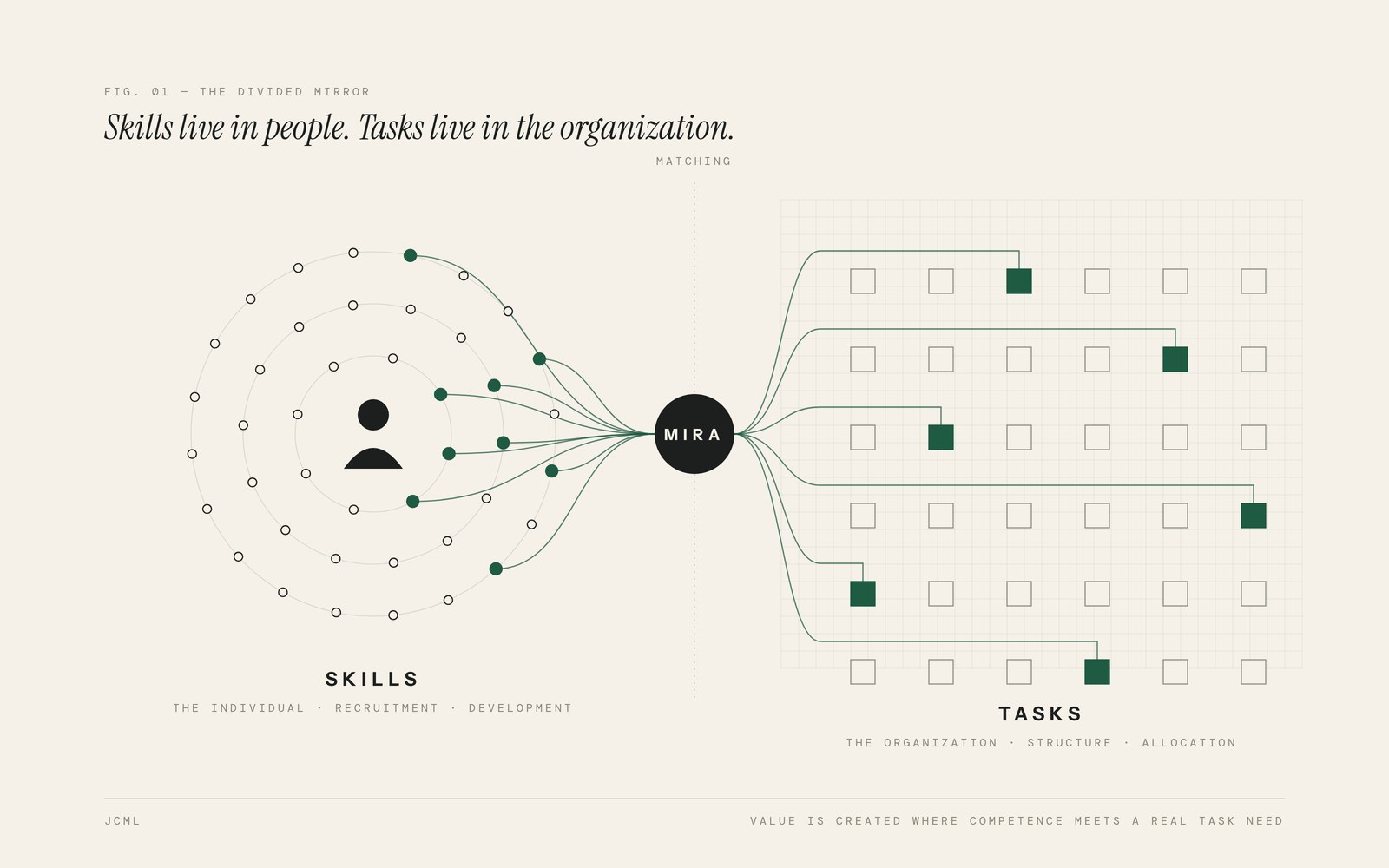
- Task mapping: All real tasks in the organization are mapped, including the level of competence each one requires.
- Semantic translation: Tasks are translated into skill requirements, regardless of which department or title they have traditionally belonged to.
- Cross-functional matching: Candidates and employees are matched against the organization’s full task needs – not one box in the org chart.
| Dimension | Traditional model | MIRA model |
|---|---|---|
| Starting point | Job description | Real tasks across the organization |
| Matching | Candidate against a single role | Candidate against the organization's full task needs |
| Structure | Follows departmental silos and hierarchy | Independent of silos |
| Outcome | One department gets help | Help lands wherever the need is greatest |
5. The example: one hire, three bottlenecks
Imagine a company where marketing, sales and customer support are all stretched thin. All three managers need a new hire, but the CEO only has budget for one.
| Model | How the position is spent |
|---|---|
| Silo model (One department gets the hire – 40% filled with lower-priority work) | Marketing: Critical tasks (60%) · Filler tasks (40%) |
| MIRA model (Candidate matched to acute tasks across all three departments) | Marketing (40%) · Sales (40%) · Support (20%) |
With a single hire, three departments get relief, and every payroll dollar is directed to tasks that genuinely matter. It does not solve every problem – but the organization's collective agility and capacity are significantly improved.
6. A new leadership model
When tasks flow across departments, a structural question emerges: employees need a manager, but managers typically “own” a department. If you work across three departments but report to the sales director, marketing will quickly see you as borrowed time.
The answer is to separate the leadership role in two:
| Role | Responsible for | What the role does |
|---|---|---|
| Coach (People Lead) | The person | Follows up on well-being, overall workload, growth and compensation. Sits outside departments to prevent the “140% trap”, where multiple managers demand everything at once. |
| Task Owner | The delivery | Defines quality, criteria and deadlines for tasks. Orders capacity rather than owning fixed people. |
This is not change for the sake of change. It is a necessary consequence of organizing work around tasks – and a safeguard against employee burnout when multiple teams need support.
7. From job catalog to operating system
A modern job catalog is an excellent foundation. But it only creates real value when it becomes an everyday management tool. With MIRA, the catalog becomes a living instrument providing:
- Capacity visibility: which tasks lack resources right now?
- Targeted learning: which skills should employees acquire next, based on upcoming task demands?
- Precise recruitment: new employees are hired with skills directly tied to active task needs.
- Clear expectations: employees know exactly which tasks their skills are meant to solve – and where their path leads next.
Conclusion
The skills-based approach is the future of how we understand and value human potential. But value is only realized when skills turn into solved tasks.
The organizations that succeed will be those that unite both perspectives: skills for the people, tasks for operations. That combination builds organizations that are both more agile and more profitable – and employees who see the direct impact of their work every single day.
“We develop skills for our people. We organize by tasks for our customers. MIRA connects the two.”