
1. Executive summary
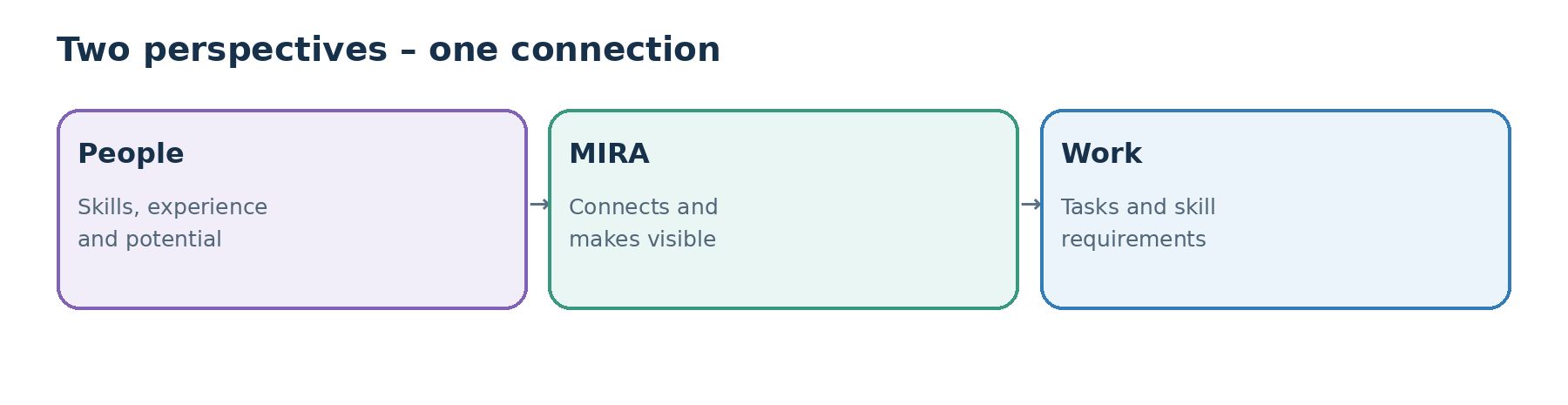
Organizations need people with skills. But skills create value only when they are put to work on real tasks. At the same time, working life is more complex than an organizational chart suggests: similar tasks are performed in different departments, one job can cover several areas of responsibility, and people have abilities that are not always visible in their job titles.
MIRA starts with two questions: What can our people do – and what does the organization need to get done? A task-based role model provides a structure between these perspectives. Tasks and responsibilities are grouped into recognizable roles, while a job can comprise one or several roles. Skill requirements can then be explained by the work that actually needs to be performed.
This is a conceptual target model: a picture of how MIRA can provide a more precise language for work and skills across organizations and digital solutions.
2. Job descriptions are useful – but not enough
A job description brings together tasks, responsibilities and expectations in one organizational position. That makes it valuable for employment agreements, management and planning. The difficulty arises when the job also becomes the only unit we use to understand skill requirements and organize work.
Two people with the same job title may perform different tasks. Conversely, people with very different titles may share much of their actual work. When skill requirements are attached only to the title, it becomes difficult to see what is genuinely similar – and what is different.
Three common challenges
- Vague expectations: “Good collaboration skills” says little about which collaborative tasks must be carried out, with whom, and with what responsibility.
- Limited reuse: Supplier follow-up may be described afresh in procurement, operations and project work, even when much of the underlying work follows the same principles.
- Hidden transferability: An employee may have relevant skills for new tasks without those skills being apparent from their current job title.
3. From job titles to the building blocks of work
MIRA does not propose abolishing jobs. The point is to understand them better. By describing the tasks being performed and grouping related tasks and responsibilities into roles, we create a structure that supports existing organization while allowing new combinations.
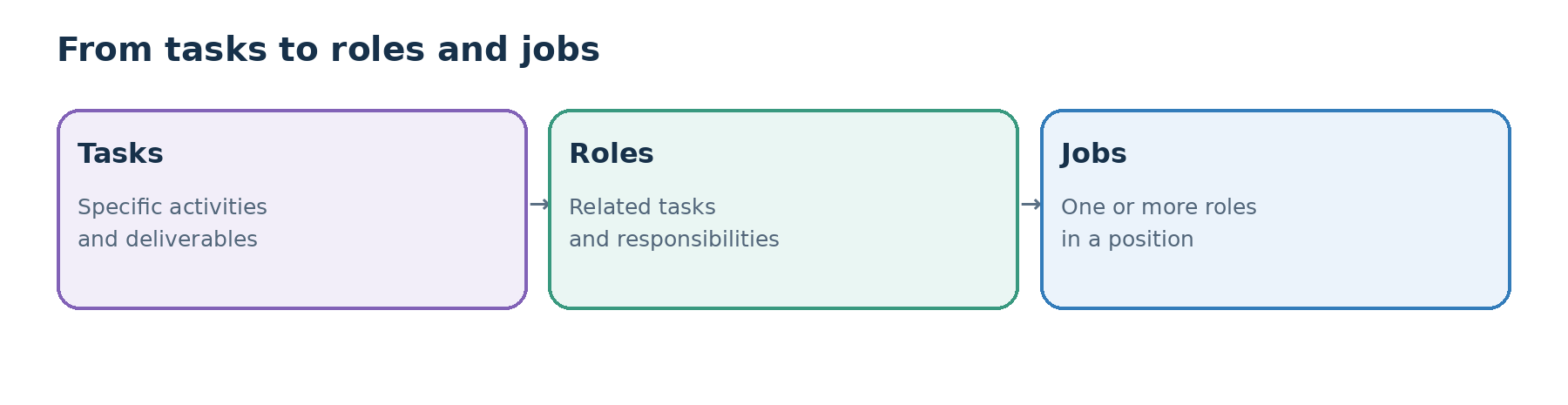
A task is a specific activity or deliverable. A role brings together tasks and responsibilities that naturally belong together. A job is the organization’s overall description of the work a person is employed to perform.
4. Roles provide structure without tying work to titles
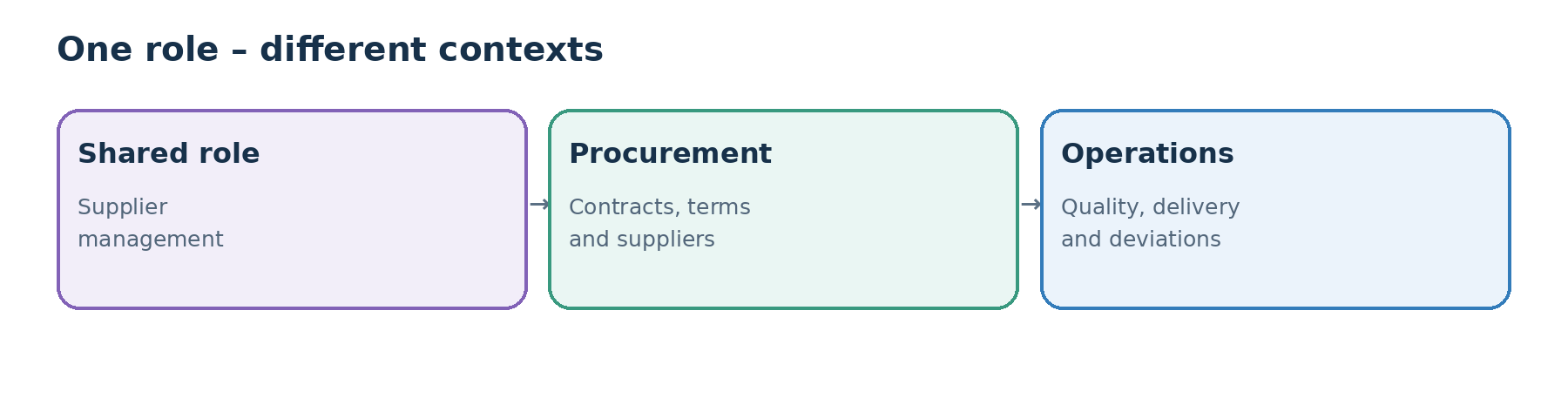
A role is more than an arbitrary list of activities. It represents a recognizable area of tasks and responsibility with a clear purpose. “Supplier management”, for example, may include communicating with suppliers, checking deliveries, handling deviations and following up contracts.
A procurement specialist may have this role as a central part of their job. An operations manager may hold the same role as one of several. The scope of the tasks may differ, but the core responsibility remains recognizable. In this way, the role becomes a shared language across organizational contexts.
Shared structure – local reality
A standardized role description can provide a common starting point while an organization still specifies local tasks, boundaries of responsibility and requirements. Standardization does not mean everyone must work in the same way. It makes comparable elements visible without concealing what is distinctive.
One job can combine several roles
A project manager, for instance, may combine project coordination, customer follow-up and financial monitoring. Another job may contain only some of these areas of responsibility. Describing the combination makes it easier to explain what the job actually requires, and why.
We organize work through tasks and roles – but we develop people through skills.
5. From what must be done to what people must know
Skill requirements should be explainable. If an employee must handle supplier deviations, they may need to analyze information, communicate clearly, assess alternatives and document decisions. Those requirements arise from the task, rather than from a vague assumption about what a particular job title normally involves.
MIRA provides a common framework for describing relevant skills and proficiency levels. When a task is linked to these requirements, we can understand why the skill is needed. When several tasks call for the same skill, the needs can be considered together while preserving the link to the original tasks.
A practical example
| Work to be performed | Potential skill requirement |
|---|---|
| Follow up deliveries and deadlines | Planning and coordination |
| Resolve deviations with a supplier | Communication and collaboration |
| Assess the consequences of a deviation | Analysis and problem-solving |
| Document actions and decisions | Structured working methods and digital tools |
This example is illustrative: the relevant skills and proficiency levels must be assessed in light of the actual tasks and their context.
6. Having the skills is not the same as holding responsibility
Having the skills required for a role does not automatically mean that a person has been assigned that role. Skills describe what a person can do. The role describes tasks and responsibilities. Role assignment is an organizational decision. This distinction matters for clear expectations, responsible allocation of work and respect for formal authorization requirements where applicable.
A task-based description can therefore reveal existing capabilities, learning opportunities and relevant new areas of work – without erasing managerial accountability or the organization’s authority to make assignments.
7. One organization – several ways to use skills
Imagine an organization with procurement, operations and project delivery functions. All three work with external suppliers, but describe the work differently. Procurement emphasizes contracts and terms. Operations emphasizes delivery quality and deviations. Projects emphasize progress and coordination.
A task-based role model makes it possible to identify the common core of supplier management while keeping local tasks and boundaries of responsibility visible. The organization can then compare skill needs more easily, develop more targeted training and describe jobs consistently.
What could this make possible?
For managers: better insight into which tasks actually need to be completed and where accountability sits. For HR and recruitment: more precise requirements and a stronger basis for recognizing transferable skills. For employees: clearer expectations and more potential development paths. For learning: training linked to concrete tasks rather than generic skill aspirations.
These benefits are not automatic. They depend on sound task descriptions, professional judgment and active use of the information in day-to-day operations.
8. A model that can be used across different solutions
MIRA is a framework, not the name of a single application. It provides a shared language for the relationships between tasks, roles, jobs and people’s skills. Different digital solutions can apply this language for different purposes – from job descriptions and skill development to planning and mobility.
People have skills. Organizations have tasks. MIRA connects the two.
9. A clearer picture of both people and work
The skills-based approach has shifted attention from titles and formal backgrounds toward what people can actually do. That is an important step forward. But for this knowledge to create value, it must be connected to the tasks the organization needs completed.
The MIRA Role Model brings greater structure to this connection. Tasks make work requirements concrete. Roles group tasks and responsibilities into recognizable units. Jobs show how these units are combined within an organization. Skill requirements can be explained through the work, and people’s abilities can be assessed against real needs.
The aim is not to make organizations more complicated. It is to create a more precise, flexible and understandable language for what already happens: people use their skills to perform work and deliver results.
Four principles behind the concept
| Principle | What it means |
|---|---|
| Tasks first | Describe the work concretely before assessing requirements and organization. |
| Roles as building blocks | Related tasks and responsibilities can be reused across jobs. |
| Skills with a rationale | Skill requirements should be traceable to the tasks they support. |
| People and organization | Keep skills, qualification and actual role assignment distinct. |
Skills for talent – Tasks for organizing
This whitepaper presents the MIRA Role Model as a professional concept and target model. It does not claim that every application described here already exists as implemented functionality. It can be read alongside the MIRA introduction video and the whitepaper “From Skills to Value Creation”.